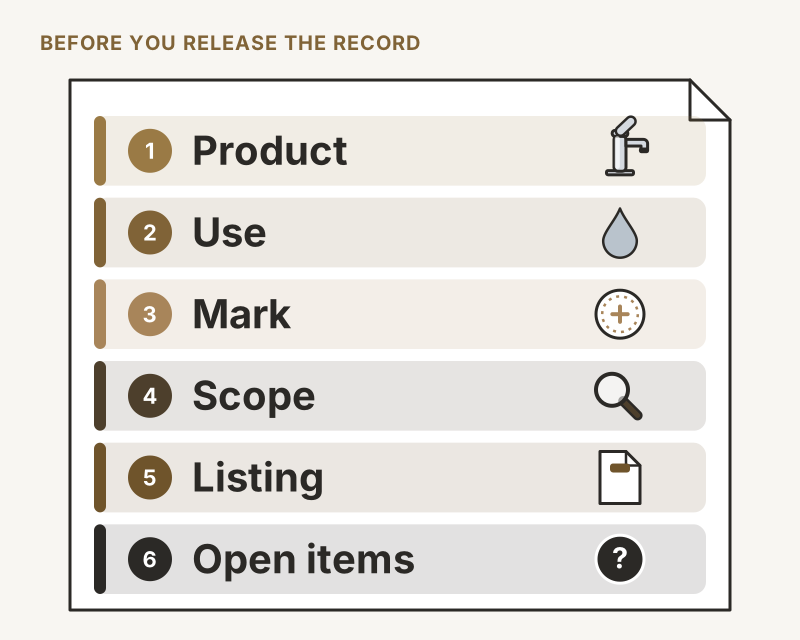
From identity to release
What must you identify before reading the mark?
Start with the offered product, not the brand’s general statement. Record the model, configuration and responsible manufacturer or importer, then state the intended market and use. A catalog family, a valve body and the final faucet assembly may describe different scopes.
40 CFR 143 SubpartB includes bathroom lavatory faucets in its plumbing-fitting definition. Its potable-use definition includes teeth brushing. This is why “it is in a bathroom” is not a sufficient scope decision.
| Record | What to establish |
|---|---|
| Offered assembly | Model and configuration to be reviewed |
| Use and market | US application and the intended water use |
| Claimed evidence | Which document or listing supports which statement |
| Open applicability question | Responsible party to confirm it before acceptance |
How should the buyer review the evidence?
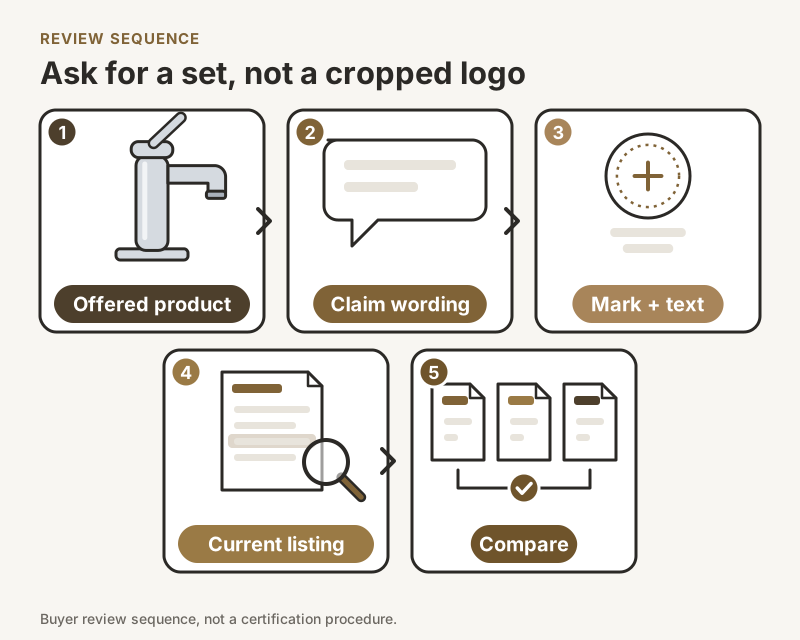
Request an identifiable set rather than a cropped logo forwarded without context. A supplier may have good evidence that simply does not cover the item being offered.
- Identify the exact offered product configuration and the entity responsible for its evidence.
- Record the wording of the claim as received; do not silently expand lead-free into a broader health or performance statement.
- Obtain the mark and nearby identifier text from the actual product or packaging, where available, with a link to the offered model.
- Find the issuing body’s current listing or obtain a clarification that identifies the model and scope.
- Compare the listing, offered model and accompanying evidence; record conflicts rather than choosing the most reassuring version.
- Ask the responsible party to resolve applicability and documentary gaps before the buyer closes the file.
This sequence organizes questions. It does not replace an authority’s compliance decision or a certification body’s interpretation of its listing. Keep the original supplier wording alongside the reply so that the evidence trail shows what changed.
Which claims should remain separate?
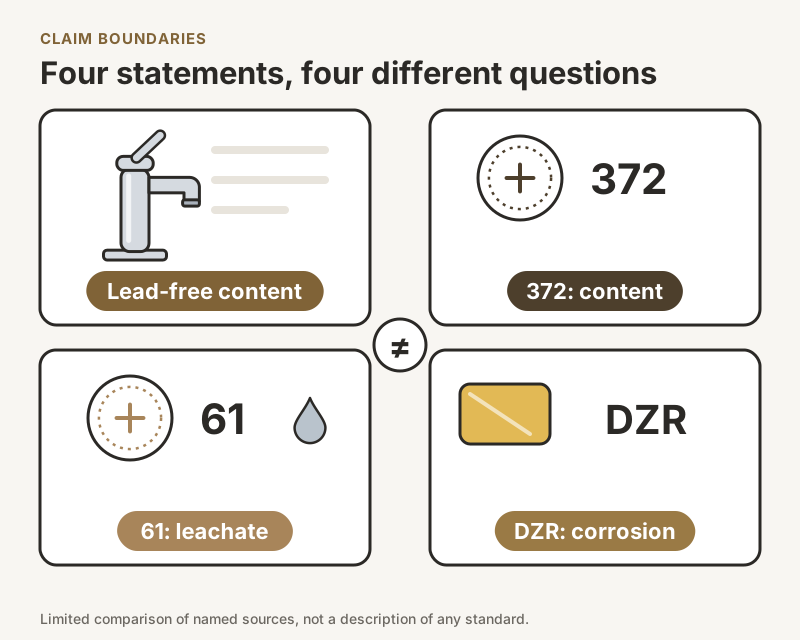
The current US rule and EPA’s mark guide have different roles: the rule sets legal requirements; the guide helps readers interpret certification information.
Swipe or use the arrow keys to see what it does not establish.
| Statement | Limited meaning for this review | What it does not establish |
|---|---|---|
| Lead-free content claim | The rule defines a weighted average over wetted surfaces | Not an alloy composition claim for every piece of the faucet |
| NSF/ANSI/CAN 372 identifier | EPA describes lead-content conformity scope | Not the additional leachate scope described for 61 |
| NSF/ANSI/CAN 61 identifier | EPA’s guide describes additional leachate scope | Not permission to skip model and listing verification |
| DZR statement | A separate corrosion evidence question | Not a substitute for the lead-free evidence |
Use the exact language of the actual evidence. This is a limited comparison of the named sources, not a complete description of either NSF standard, its tests or every certification route.
How can a review file expose a mismatch?
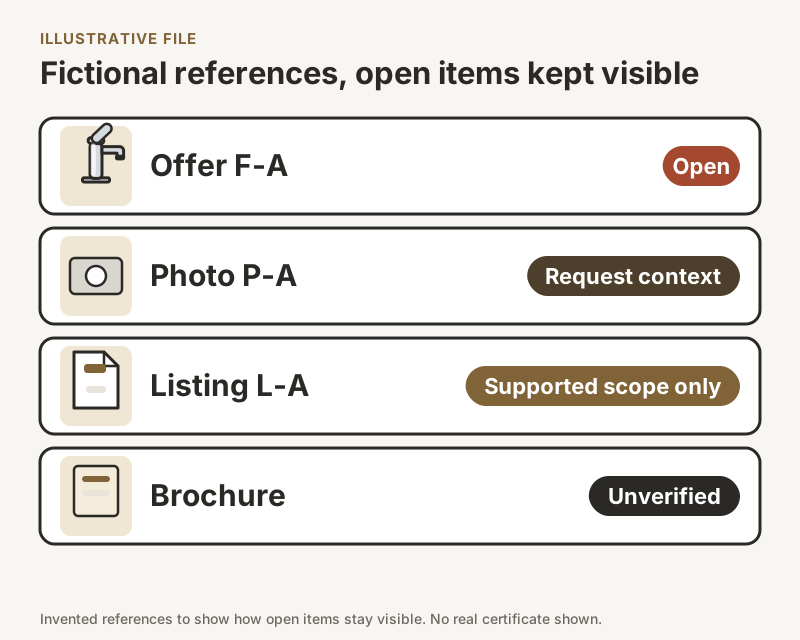
These references are invented to show how open items should remain visible; they do not depict an issued certificate or a real product.
Swipe or use the arrow keys to see disposition.
| Received item | Comparison to make | Disposition |
|---|---|---|
| Offer F-A | Does the current listing identify offered F-A? | Open until identity confirmed |
| Photo P-A | Is the nearby identifier text readable? | Request complete context |
| Listing L-A | Does its scope support the quoted statement? | Record supported scope only |
| Changed trim or assembly | Is the change within the identified product scope? | Ask issuer/responsible party |
| Undated brochure statement | Does it link to current evidence? | Keep as unverified marketing claim |
The decision should say what was checked and what remains unknown. A file with several positive-looking documents may still contain no evidence for the particular offered configuration. Do not turn an unresolved line into approved merely because another model appears in the same catalog.
What should you read with the certification mark?
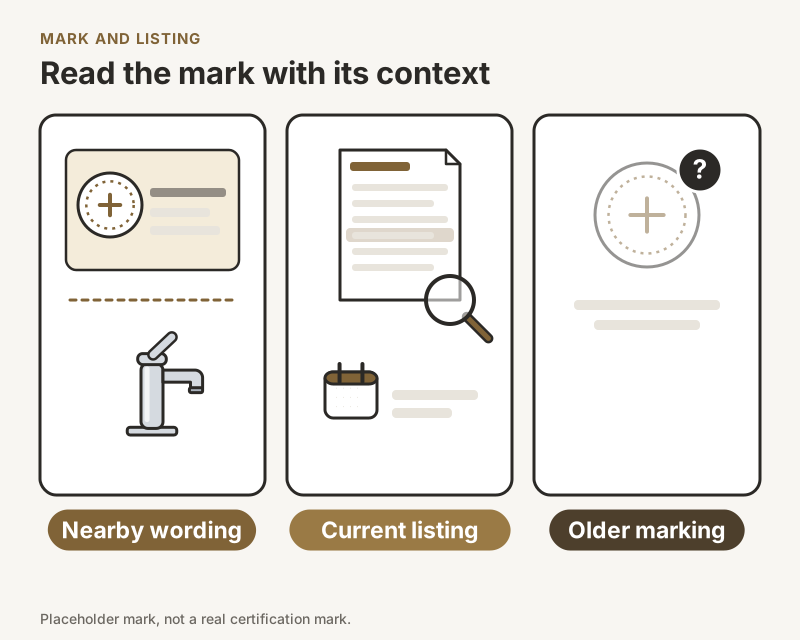
EPA’s identification guide explains why identifier text, older marking context and the actual listing matter. This proposed review treats them as one evidence set.
Preserve nearby wording
Record the mark with its identifier text and the product or packaging reference. If space or the image prevents reading it, request confirmation rather than guessing what it would say.
Use current identity evidence
Compare the offered model to the issuer’s listing and the evidence revision. A logo alone does not perform that comparison. Keep the date of the lookup with the file.
Handle older or ambiguous wording
EPA notes that older 61 marking needs further verification. Ask for the current listing or clarification; do not extrapolate from the mark’s appearance or from another supplier’s product.
- Keep the original image or supplied reference in the private order file.
- Record the issuer and exact model entry consulted.
- State supported scope and remaining uncertainty separately.
Why should exemptions and certification routes be referred back?
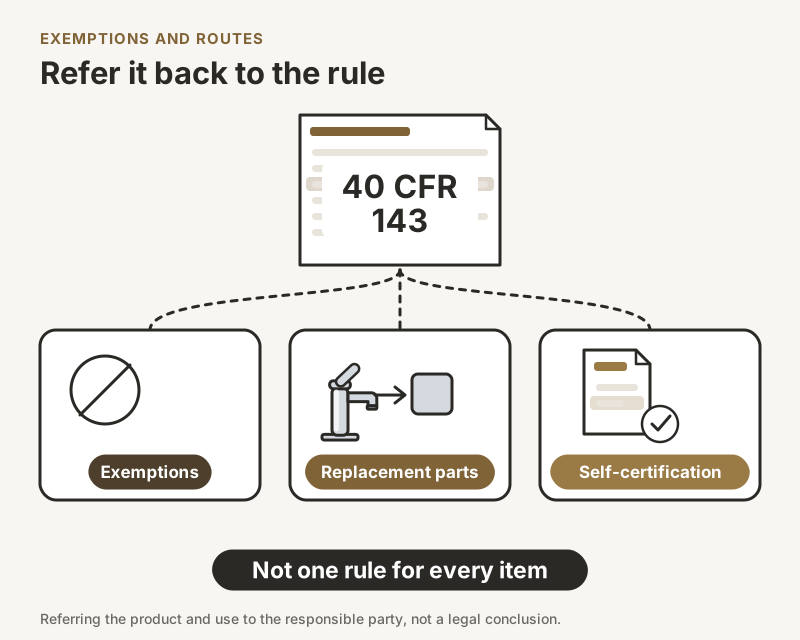
40 CFR 143.16 and 143.19 include exemptions, component/replacement provisions and defined self-certification routes. A blanket “every bathroom item needs the same third-party certificate” is therefore not a reliable review rule.
Confirm the product and actual use
Ask the responsible manufacturer/importer to explain the claimed basis for the offered product. Do not assign an exemption by a vague sales label.
Ask for the applicable evidence route
If the party relies on an alternative route or a replacement-part provision, request the evidence for that basis and refer unresolved applicability to qualified review.
Keep the conclusion within scope
This page does not decide whether a particular custom product or replacement part qualifies. It provides a place to record that question and the responsible answer.
A scope question is not resolved by changing the quotation wording. Keep the offered product identity, asserted basis and supporting evidence together, and do not declare a whole project compliant from this review.
What should the RFQ ask the supplier to identify?
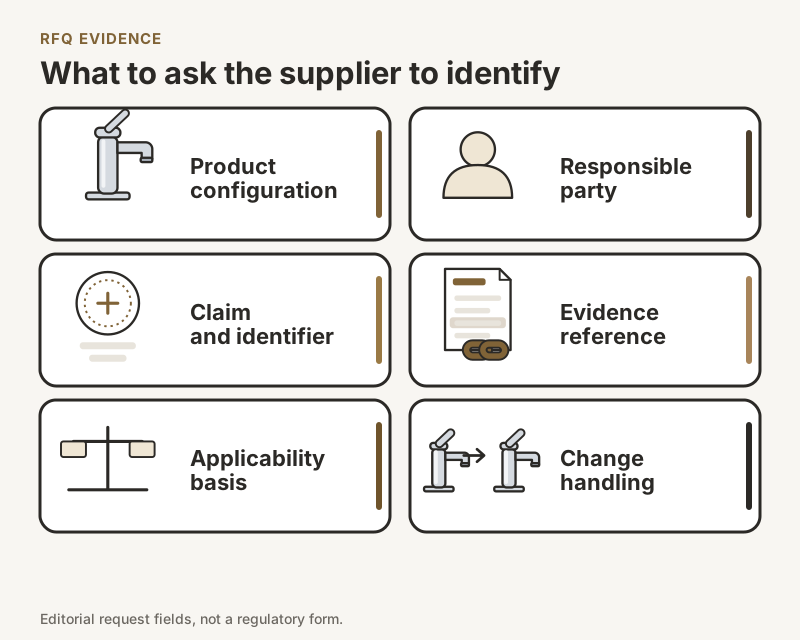
Request a response that can be checked against the actual offer. These are editorial request fields, not a prescribed regulatory form.
Swipe or use the arrow keys to see unresolved state.
| Field | Buyer question | Unresolved state |
|---|---|---|
| Product configuration | Which model and assembly are offered? | Family name only |
| Responsible party | Who stands behind the evidence? | Unclear entity or role |
| Claim and identifier | What exactly is being asserted? | Logo without context |
| Evidence reference | Where is the current model scope? | Different or missing model |
| Applicability basis | Who confirms use and route? | Assumption without explanation |
| Change handling | What if the offer changes? | Old evidence silently reused |
How do you close conflicting evidence?
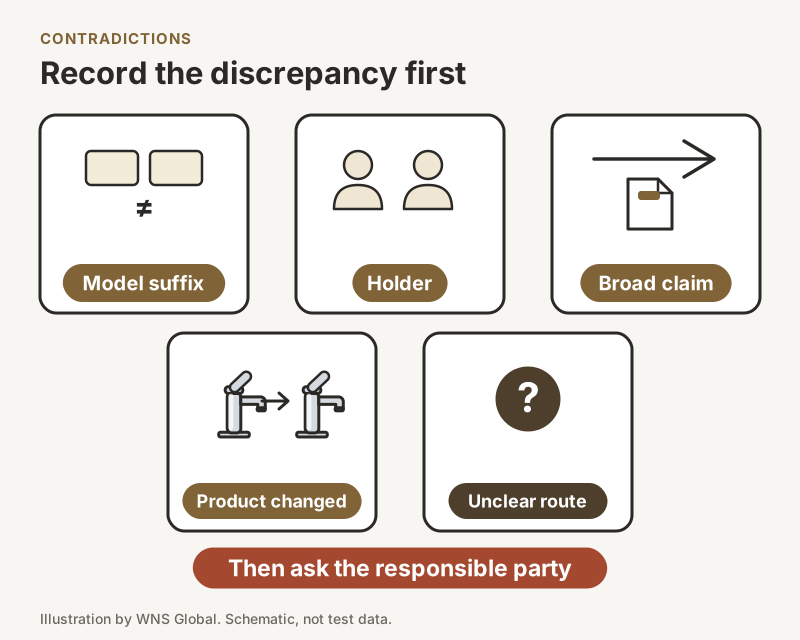
Record the discrepancy first, then request a response that identifies the document or product affected.
- Different model suffix Ask whether the listed suffix covers the offered configuration; keep the answer and its basis.
- Different manufacturer or holder Establish the parties’ actual roles instead of forcing legitimate separate entities into one name.
- Broad sales claim but narrow evidence Revise the accepted statement to the supported scope or leave it open for further evidence.
- Product changed after review Reopen the affected identity and scope comparison before relying on the old conclusion.
- Unclear route or exemption Refer the actual product and use to the responsible qualified party; do not author an exemption in the worksheet.
Record the disposition
Preserve the original statement, the issuer or responsible party’s reply, the reviewer and the date. An acceptable closure explains the difference and identifies the evidence that resolved it; a tick with no reference does not.
What belongs in the accepted evidence index?
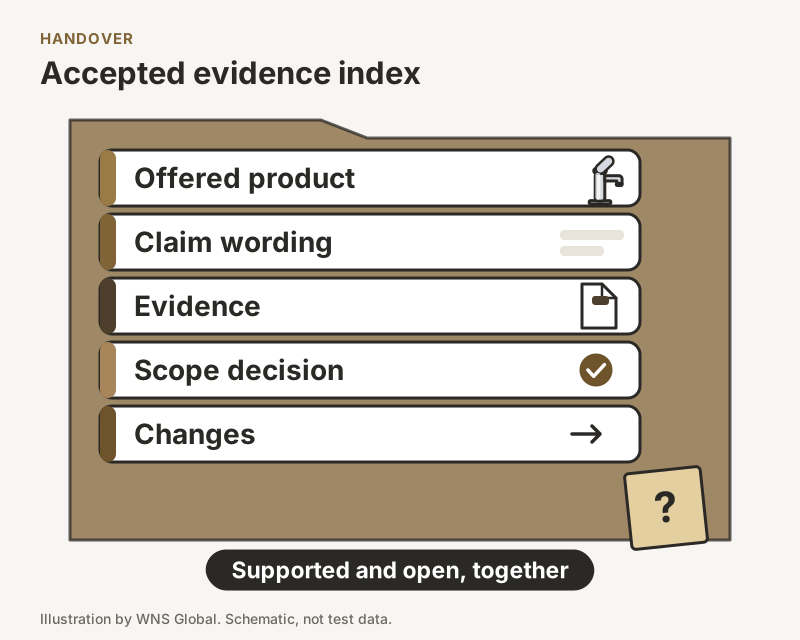
Hand over the supported statements and the open questions together, so that procurement and receiving do not inherit different interpretations.
| Reference | Record to hand over |
|---|---|
| Offered product | Agreed model and configuration |
| Claim wording | Exact supported statement |
| Evidence | Issuer/listing/document references and lookup date |
| Scope decision | Responsible clarification and any qualification |
| Changes | Reopened comparisons and current disposition |
Before you close the file
- The file identifies the actual offered configuration.
- The claim matches the evidence scope.
- An unresolved applicability question stays open.
- A later product change triggers another comparison.
This guide does not claim any WNS Global faucet is lead-free certified, DZR, listed or accepted for a US project. Supply and documentation scope require separate written confirmation.