Context and practical distinctions
Choose the question before choosing the appointment
Begin by deciding what you want to learn: how a product looks, whether a configuration suits a project, what an organization manufactures, or how a sample will be recorded. A showroom conversation, an exhibition meeting and a production-site visit can each help with a different question. This is practical planning guidance, not an organizer’s promise about access.
Write down the purpose of each appointment and the information you hope to take away. A short product brief and a list of open questions are more useful than assuming that every stop will provide a tour, a quotation and a finished specification.
| Question | Evidence or boundary |
|---|---|
| City or event | Read the named public source within its scope. |
| Individual organization | Confirm the activity and identity separately. |
Understand the display setting
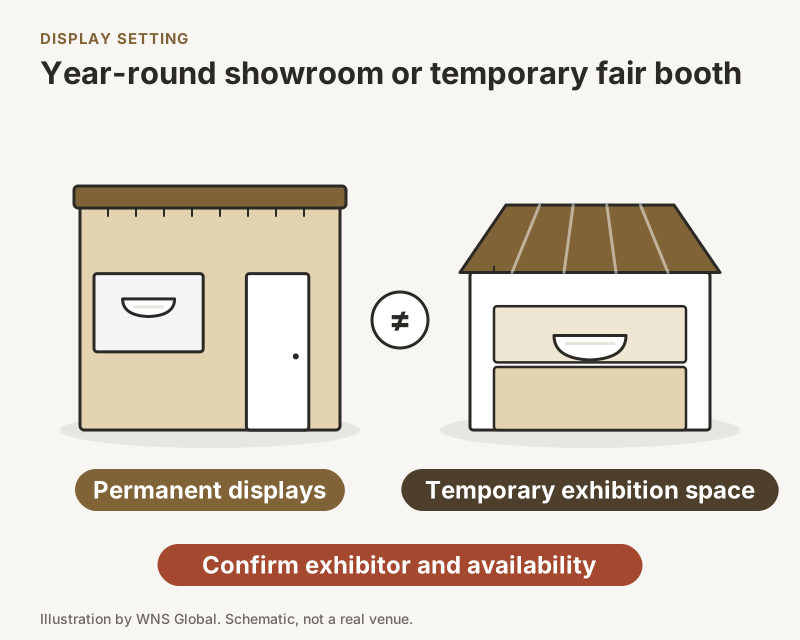
Use S3’s format distinction, then independently confirm the exhibitor and meeting. This is guidance, not an organizer service promise.
Sources: S3: CeramBath organizer
Original generated SVG editorial artwork; not a photograph or verified factory record.
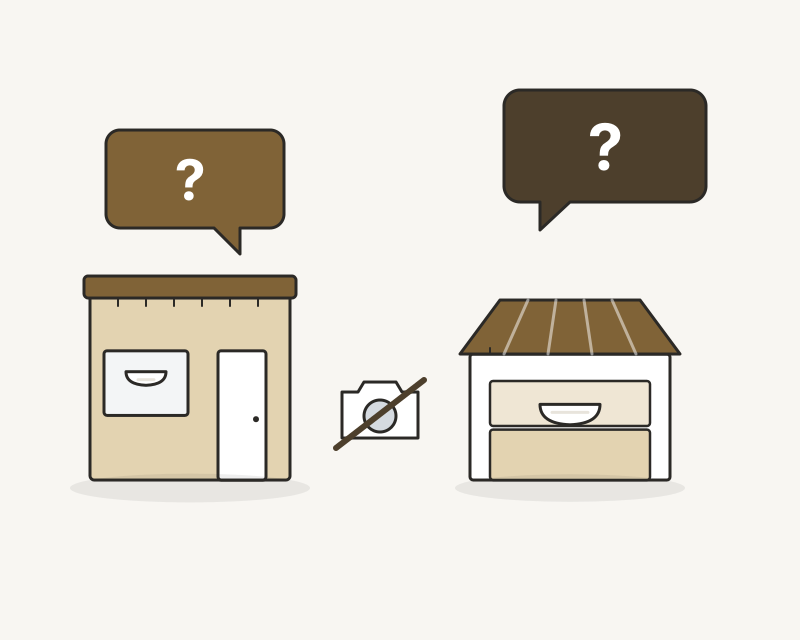
The CCC organizer page distinguishes permanent displays and temporary exhibition space. Read the CCC venue description. A year-round showroom visit differs from a meeting at a temporary fair booth. Confirm the specific exhibitor, location and availability instead of assuming a calendar entry guarantees access to a particular showroom.
- Identify the subject being discussed.
- Read the date and scope of its source.
- Keep interpretation separate from documented facts.
Use a display visit to discuss samples, finish choices, component scope and the documents available for review. The display itself does not verify the manufacturing site. Record which statements came from a representative and which documents identify the company or product.
Select venues by subject rather than by name alone
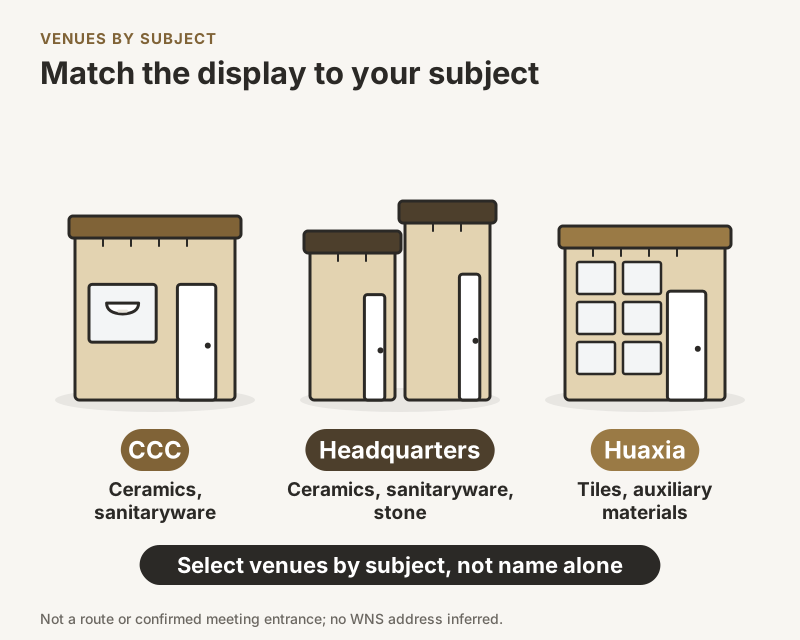
Organizer-listed location references from S3–S5. Not a route or confirmed meeting entrance; no WNS address inferred.
Sources: S3: CeramBath organizer S4: CeramBath organizer S5: CeramBath organizer
Original generated SVG editorial artwork; not a photograph or verified factory record.
The headquarters venue has showroom buildings featuring ceramics, sanitaryware and stone. Check its venue description. Huaxia is described with a tile and auxiliary-material emphasis. Check the Huaxia description. These differences are useful when deciding which displays match your interests.
| Venue | Organizer-described setting |
|---|---|
| CCC | Permanent and temporary displays; ceramics and sanitaryware. CCC venue |
| Headquarters | Showroom buildings with ceramics, sanitaryware and stone. Headquarters venue |
| Huaxia | Tiles and auxiliary-material emphasis. Huaxia venue |
The organizer lists CCC at No. 2, 3rd Jiangwan Road and the headquarters venue at No. 68, West Jihua Road, both in Chancheng; Huaxia is on Taobo Avenue in Nanzhuang. Verify the exact meeting entrance with the host before travel. These are organizer-listed venue addresses. Check the CCC, headquarters and Huaxia venue pages, and confirm the specific meeting location separately with the host. These listings do not establish where WNS receives visitors or manufactures products.
Keep the contracting party and production site separate
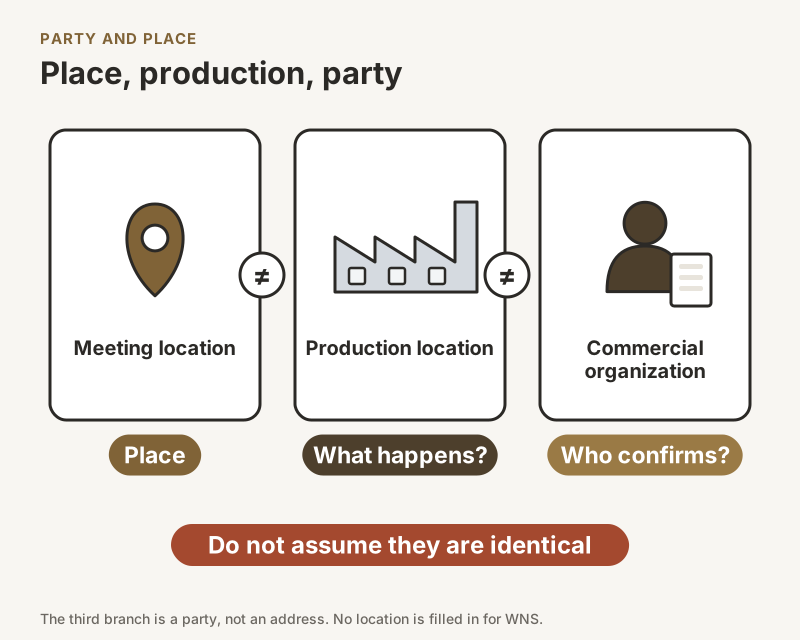
The third branch is a party, not an address. No relationship or location is filled in for WNS.
Original generated SVG editorial artwork; not a photograph or verified factory record.
Ask who you will meet, which organization issues commercial documents and what activity occurs at the proposed site. A showroom address, a registered business address and a production address may serve different purposes. This guide does not assume that they are identical or that one type of organization is inherently preferable.
| Place or party | Question to ask |
|---|---|
| Meeting location | Where will we meet, and who will be present? |
| Production location | Which activity happens at the proposed site? |
| Commercial organization | Who confirms the scope and issues documents? |
A manufacturer, a trading company or a coordination team may have different responsibilities. Establish who can answer technical questions, who confirms the supplied configuration and who handles follow-up. The distinction should clarify accountability rather than become an accusation based on a company label.
Confirm access and practical arrangements
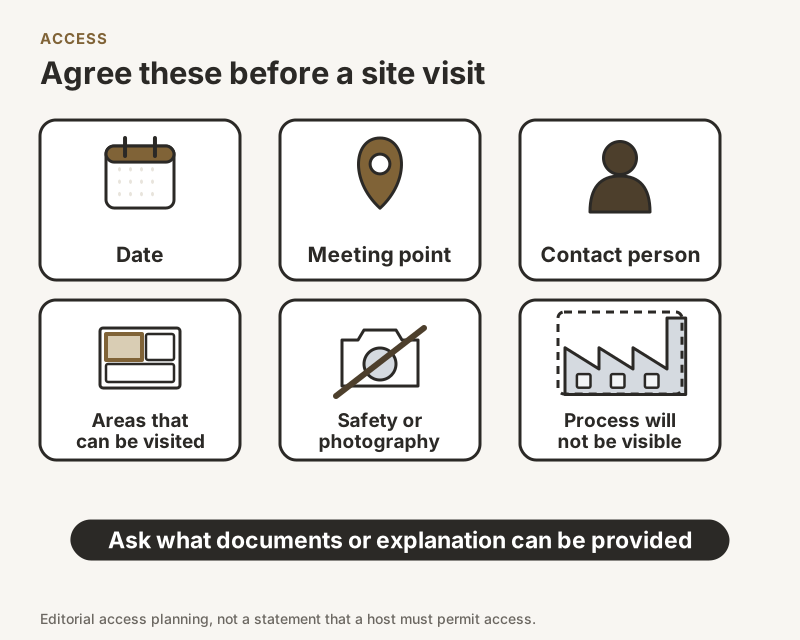
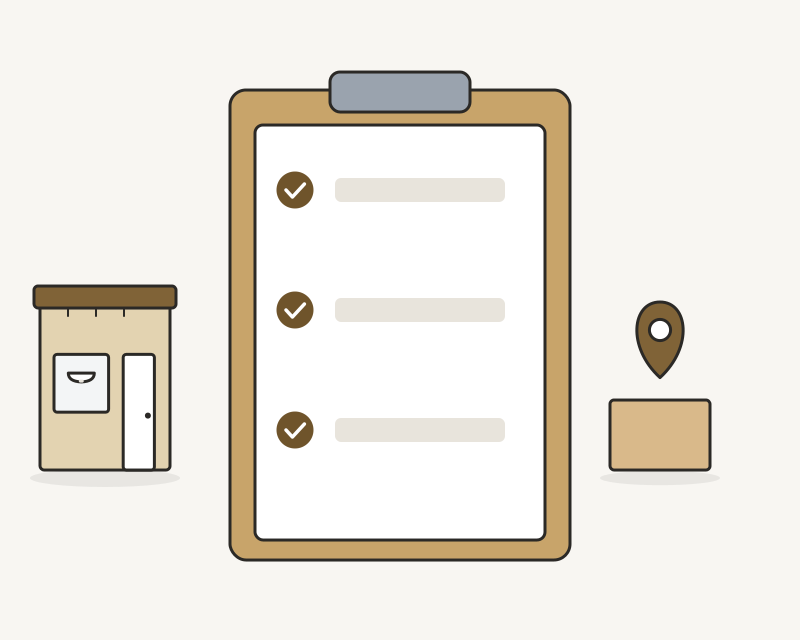
Editorial access planning, including the fallback when a requested process cannot be seen.
Original generated SVG editorial artwork; not a photograph or verified factory record.
Before a production-site visit, agree on the date, meeting point, contact person, areas that can be visited and any applicable safety or photography instructions. Ask whether the people needed for technical questions will be available. These are preparation suggestions; they are not statements that a host must permit access to every process.
Scope of the information
Do not schedule around unconfirmed meeting arrangements, pickup or an unrestricted workshop tour. If a process will not be visible, ask what documents or alternative explanation can be provided. Respect other customers’ information and do not assume photographs of samples or work in progress are available for publication.
- Use the source for its stated subject.
- Do not infer company capability from the setting.
Bring a brief that separates known and open details
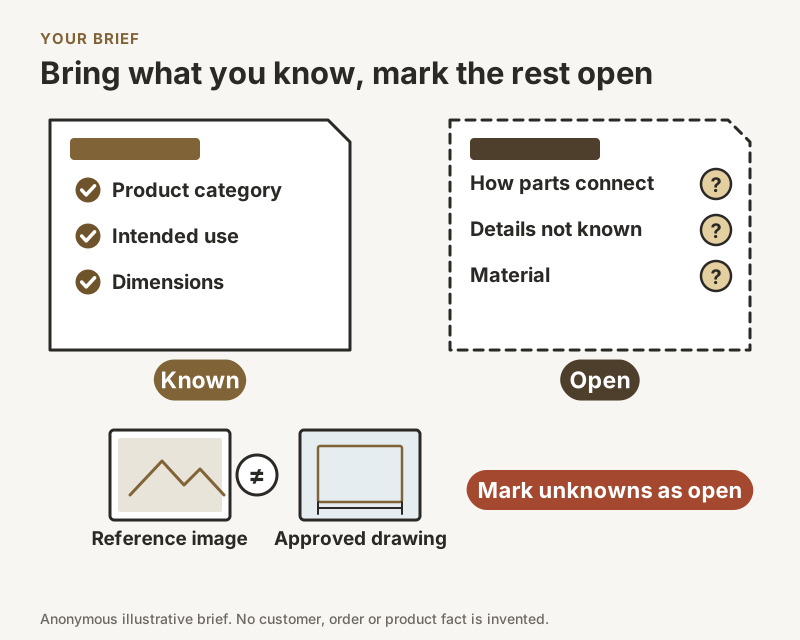
Anonymous illustrative brief: known fields, open fields and a reference/approval distinction. No customer, order or product fact is invented.
Original generated SVG editorial artwork; not a photograph or verified factory record.
For product discussions, bring the product category, intended use, relevant dimensions and questions about how parts connect. Distinguish a reference image from an approved drawing, and a desired appearance from a confirmed material specification. If details are not known, mark them as open rather than allowing different meetings to fill them with different assumptions.
A practical distinction
If you are visiting for general learning, a topic list is enough: what happens at this setting, which roles are represented and how the source information relates to what you observe. A city or industry visit does not have to become a product inquiry.
Keep dated context and current confirmation clearly separate.
Use a factory visit to identify evidence, not just scenery
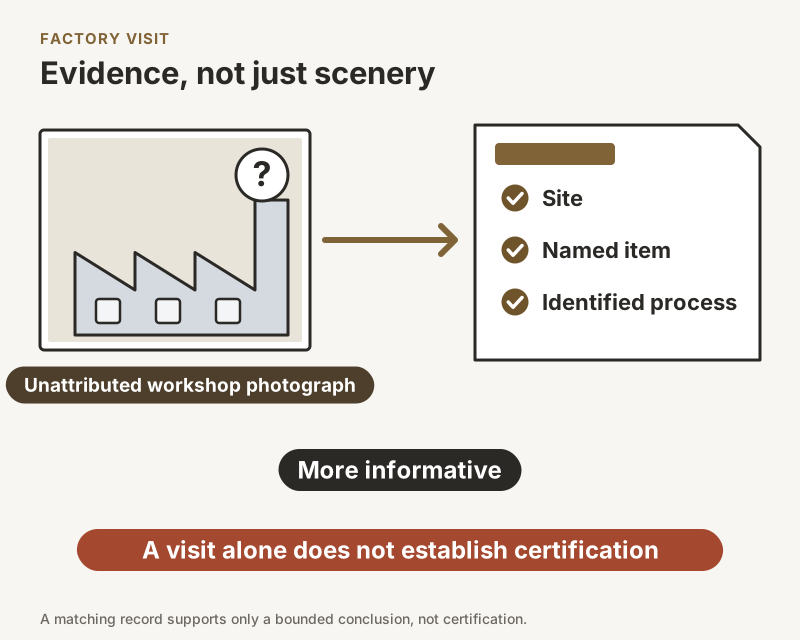
Apply each lane independently; neither visit is required to complete the other. A matching record supports only a bounded conclusion, not certification.
Original generated SVG editorial artwork; not a photograph or verified factory record.
Ask the host to explain the relationship between the product discussed and the process shown. Notes about the site, a named item and an identified process are more informative than an unattributed workshop photograph. This article focuses on preparation and what to record.
| Question | Evidence or boundary |
|---|---|
| Activity | A single visit does not establish batch quality, product compliance, maximum capacity or the origin of every component. Match each question to an appropriate document or observation. Keep statements that remain unverified in the follow-up list instead of turning them into a conclusion. |
| Unconfirmed statement | Keep it as a question rather than a conclusion. |
Check current event and transport information
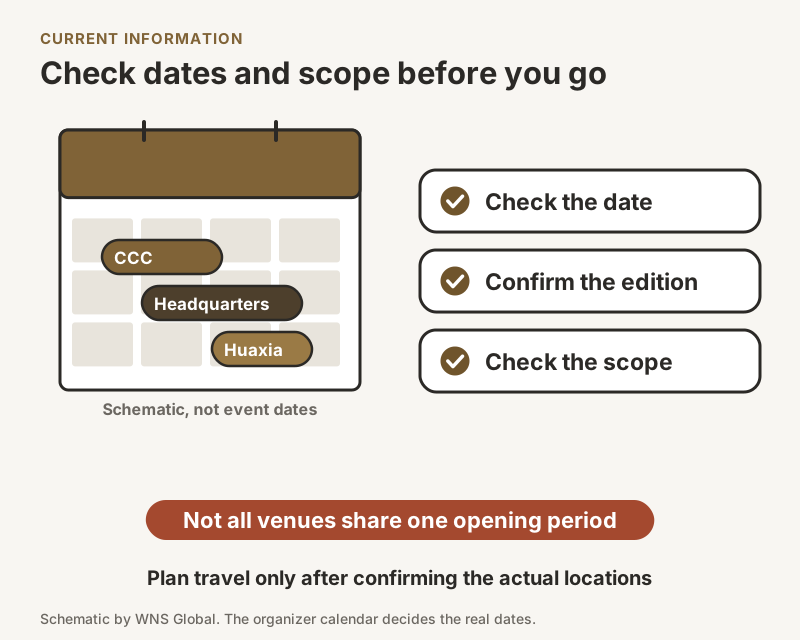
S8 supports the calendar branch only; host/transport confirmations are editorial guidance and remain independent.
Sources: S8: CeramBath organizer
Original generated SVG editorial artwork; not a photograph or verified factory record.
Use the organizer’s current introduction and calendar to check the relevant edition and each venue’s dates. Do not assume all venues share the same opening period. A permanent-display description also does not establish an individual company’s opening hours or meeting availability.
- Check the date. Confirm the edition or time period.
- Check the scope. Identify the place, activity and source.
What remains open
Plan travel only after confirming the actual locations. Check current transport information with the operator and allow for the sequence of your appointments.
Leave with an organized record and clear next steps
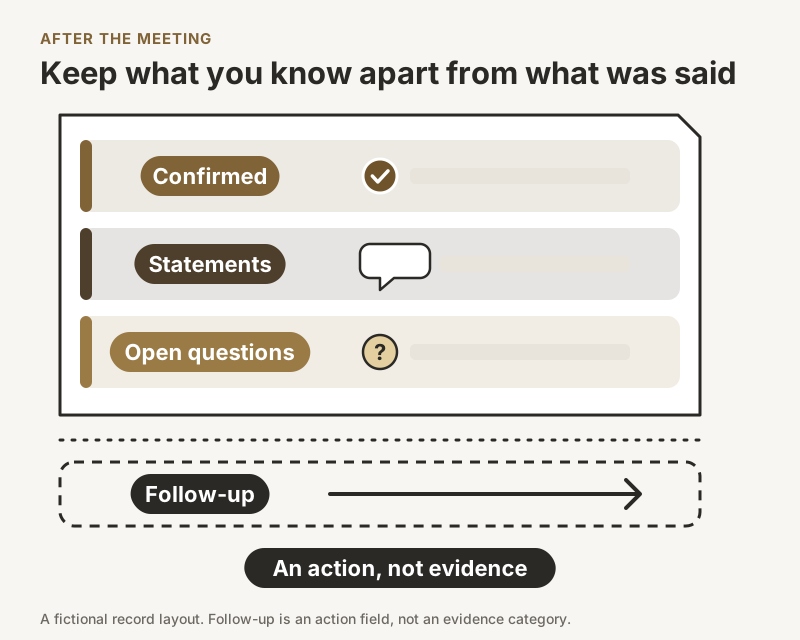
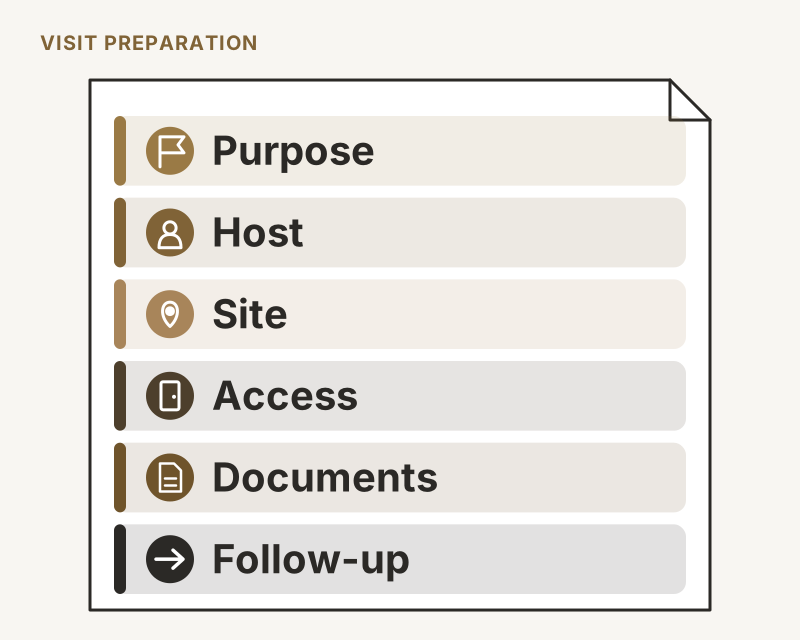
A fictional record layout separates observations, statements, open items and actions. Follow-up is an action field, not an evidence category.
Original generated SVG editorial artwork; not a photograph or verified factory record.
After each meeting, separate confirmed information, representative statements and unanswered questions. Retain the venue and organization name, relevant product or sample reference, document revision and the agreed follow-up contact. Ask permission before distributing photographs or materials that may contain customer or commercial information.
| Question | Evidence or boundary |
|---|---|
| Documented context | Retain source, date and subject. |
| Open question | Record what still needs confirmation. |
Keep the conclusion within the evidence
- No unsupported ranking or output statistic.
- No company capability inferred from regional context.
A display selection is not automatically a production approval, and a visit is not a purchase order. If a buyer decides to continue, confirm the scope and sample process separately. If the purpose was educational, the result can simply be a better understanding of the place and its activities.