
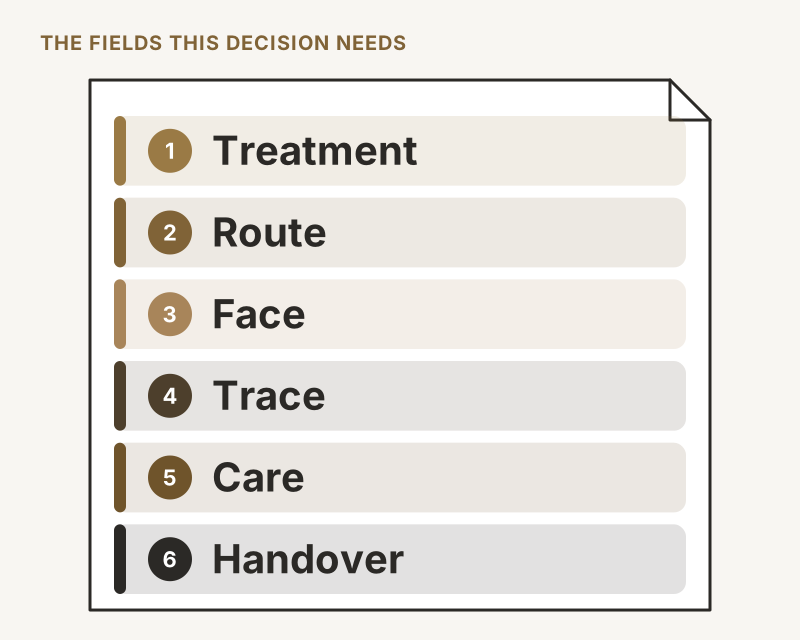
From identity to release
What should replace an unexplained easy-clean line?
Ask the supplier to identify the glass and the treatment separately. A glass thickness or a tempered-glass statement does not identify the surface treatment. A sales description can remain useful, but it should point to the product name and scope that the supplier will actually deliver.
For a multi-room order, keep the treatment field at panel level. One enclosure may have several panels, and an order may contain untreated and treated alternatives. A general statement at the top of a brochure cannot show which option reached each room.
| Record | What to establish |
|---|---|
| Glass panel | Panel identifier and agreed glass specification |
| Treatment identity | Manufacturer, product name and intended application |
| Supply route | Party applying or supplying the treatment |
| Care reference | Document for that product and market |
| Unresolved item | Owner and answer required before release |
How does the treatment enter the order package?
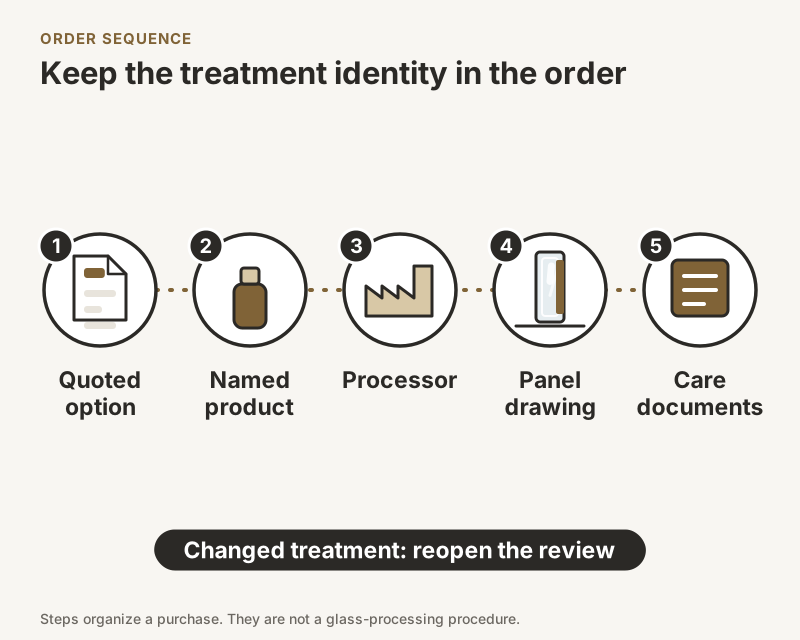
Begin with the quoted option, then keep its identity through the drawing and handover. These steps organize a purchase; they are not a glass-processing procedure.
- Ask what the easy-clean line means for the offered glass, rather than choosing a brand from this article.
- Obtain the named product information and the actual application route from the supplier.
- Have the responsible glass processor confirm the processing sequence and treated-face identification for that product.
- Add the agreed face and orientation to each relevant panel drawing.
- Link the application or supply reference to panel labels and the packing schedule.
- Obtain the current care document and applicable warranty terms for the actual destination market.
If a proposed alternative changes the treatment or application route, reopen the face and care review. An unchanged glass size does not mean the handover documents can remain unchanged.
Why should the buyer ask where the treatment is applied?
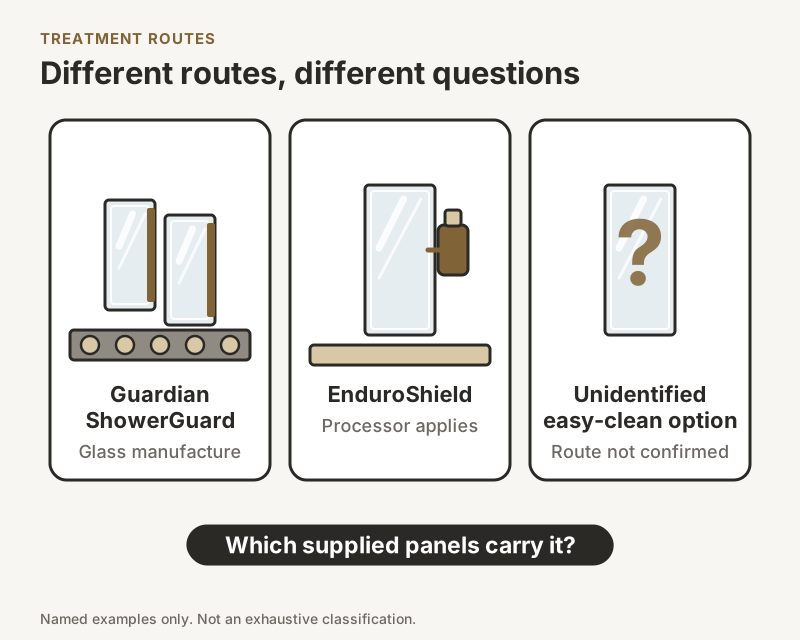
Two named manufacturer descriptions illustrate different routes. They do not create an exhaustive classification of every easy-clean product.
Swipe or use the arrow keys to see question for the offered order.
| Named example | What the public source describes | Question for the offered order |
|---|---|---|
| Guardian ShowerGuard | Treatment associated with glass manufacture | Which supplied panels carry the named glass treatment? |
| EnduroShield factory-applied | Application by the processor using its named treatment route | Who applies the specified treatment and records that application? |
| Unidentified easy-clean option | No product or route confirmed | What exactly is included in the quotation? |
Guardian product details and the ShowerGuard FAQ describe its manufacturing treatment. EnduroShield’s factory-applied page describes its own application route. Keep these descriptions attached to their names. Neither supports a statement that every wipe-on treatment is short-lived or that all factory treatments perform alike.
How should a treated face be shown on the panel drawing?
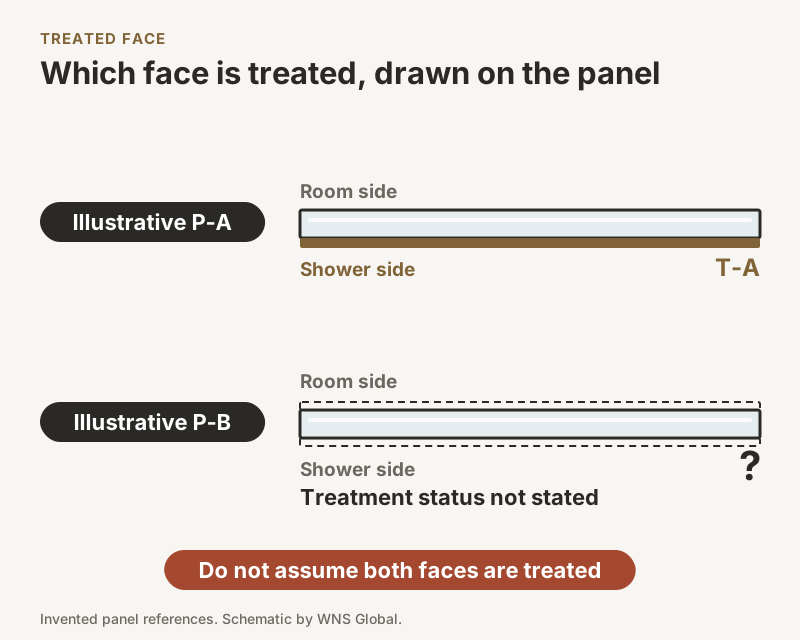
A panel face must be traceable to the glass identification and the actual installation drawing, not guessed from a generic face number.
Swipe or use the arrow keys to see confirmation needed.
| Panel reference | Drawing field | Confirmation needed |
|---|---|---|
| Illustrative P-A | Treatment on face marked T-A | Processor confirms the product-specific face designation |
| Illustrative P-A | Shower side and room side shown separately | Installer can relate the mark to the installed orientation |
| Illustrative P-B | Treatment status not stated | Resolve before assuming both faces are treated |
| Revised panel drawing | Current face mark and revision | Retire the superseded drawing in the handover set |
ShowerGuard’s FAQ describes a single treated side; its product page lists a recommended coating position for that product. Do not turn that numbering into an instruction for another system. The buyer’s output is a confirmed orientation record; the processor and installer must use the applicable product instructions.
What ties the treatment to the panels in the crate?
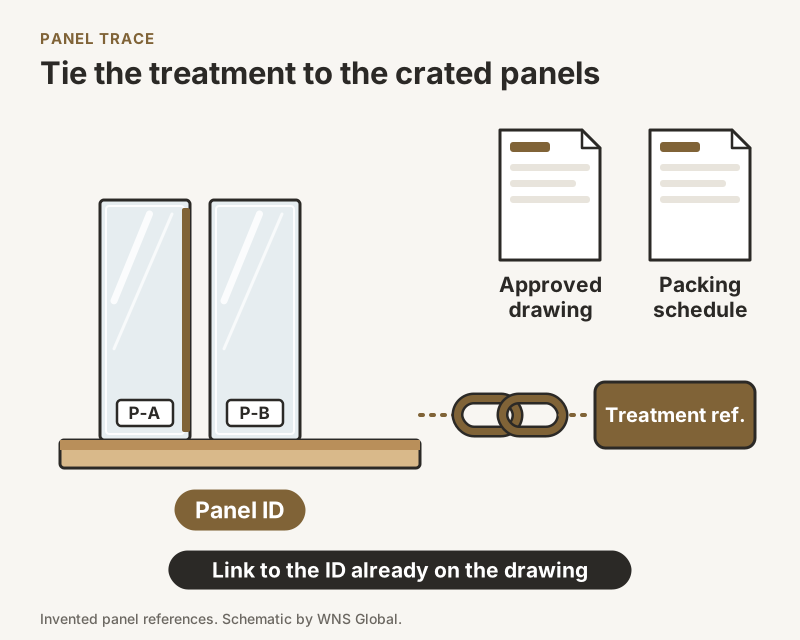
Request enough identification to connect the accepted treatment option with the delivered glass, while leaving the supplier to identify its actual record system.
Follow the panel identifier
Use the identifier already carried by the approved panel drawing and packing schedule. A separate treatment reference should connect to it rather than create an unconnected numbering scheme.
Identify the application or supply reference
A processor may provide a work order, application record or supplied-glass reference. Ask what it establishes and who is responsible for it; a proposed worksheet is not evidence that an application occurred.
Resolve substitutions visibly
If the glass source or treatment changes, preserve the original offer and the confirmed replacement. Recheck face identification and care documents rather than writing equivalent beside a different brand.
- Panel IDs appear on the accepted drawing and packing information.
- The named treatment connects to the offered panel group.
- A substitution has a recorded answer and updated handover documents.
Which care instructions belong with the glass?
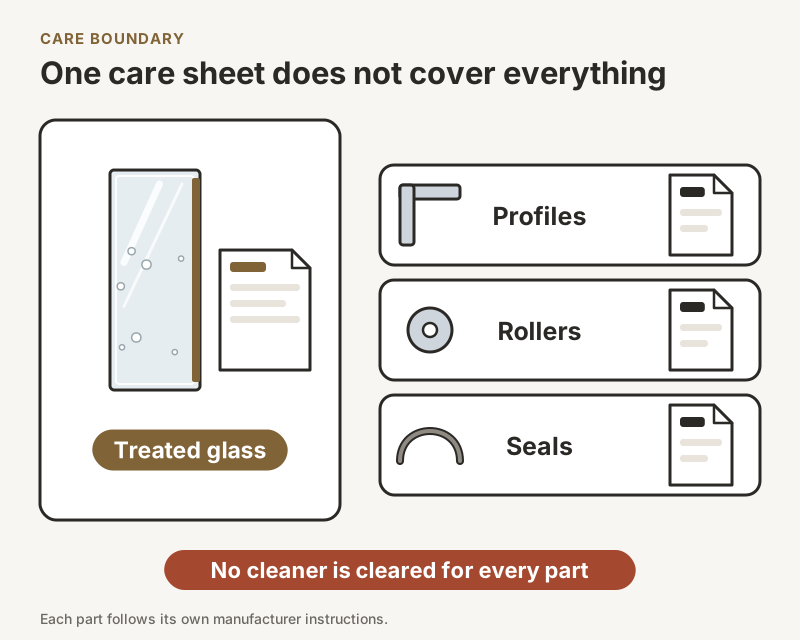
Use the named treatment’s applicable instructions, then check the instructions for adjacent finishes, seals and fittings separately. One glass-care sheet does not authorize a cleaner on every part of an enclosure.
Do not identify a treatment by water beading
ShowerGuard’s care page says its named glass is not water-repellent. An attractive droplet pattern is therefore not a universal identification test for easy-clean glass, and it is not a product-acceptance test proposed here.
Retain the actual care version
EnduroShield’s care page provides care for its own treatment. Record the market and current document supplied for the order. Do not combine a cleaner from one brand with an abrasive exception from another.
Give operators component-specific instructions
The handover should identify which instructions apply to treated glass and which apply to profiles, rollers and seals. Have the relevant manufacturers resolve a conflict before making a hotel cleaning routine.
This guide intentionally provides no cross-brand acid, abrasive or mineral-removal recipe. A cleaning team needs the accepted treatment identity and its applicable care document, including any restrictions that affect nearby materials.
What should a warranty handover preserve?
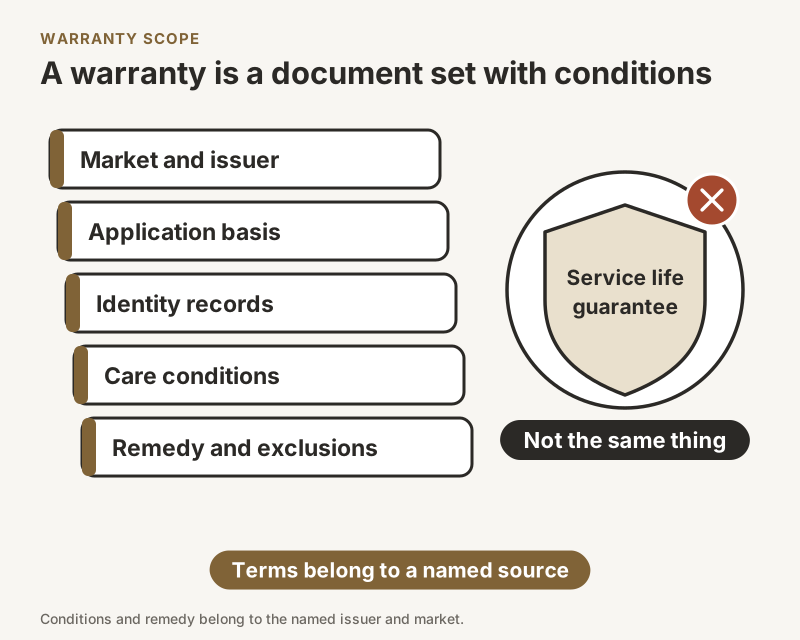
EnduroShield’s US registration page illustrates why a treatment warranty is a document set with conditions, not a synonym for a guaranteed enclosure service life. Its stated application and care conditions and limited coating remedy belong to that named source.
Swipe or use the arrow keys to see do not assume.
| Field | Ask for the actual order | Do not assume |
|---|---|---|
| Market and issuer | Applicable terms and responsible issuer | Every regional page has the same terms |
| Application basis | Confirmed applicator and treatment scope | Any glass supplier is an authorized applicator |
| Identity records | Required original label and invoice information | A photograph of an example code registers the order |
| Care conditions | Current instructions and retention requirements | Easy-clean means no maintenance |
| Remedy and exclusions | What a confirmed claim would cover | Glass, hardware and labor are automatically included |
How should the buyer handle an incomplete treatment file?
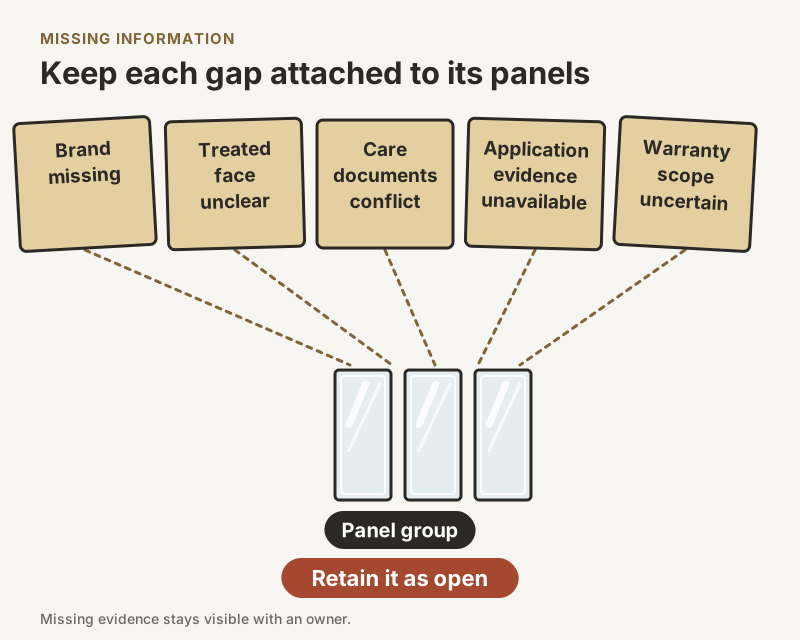
Keep the missing item attached to the panel group it affects. A vague follow-up after delivery is less useful than a question with an owner before the package is accepted.
- Brand missing Ask the supplier to identify the offered treatment and supporting information. Do not select a name by comparing marketing photographs.
- Treated face unclear Return the panel drawing to the processor for a product-specific face and orientation confirmation.
- Care documents conflict Ask which market-issued instructions govern the actual product and how adjacent materials should be protected.
- Application evidence unavailable Record what the supplier can substantiate; do not replace missing evidence with a buyer-created certificate.
- Warranty scope uncertain Keep warranty wording unresolved until the actual issuer and applicable conditions are identified.
Record the disposition
The final purchasing decision can accept a defined scope, request clarification or retain a treatment question as open. It should never imply that an unresolved face or care requirement has been checked.
What should reach the installer and maintenance team?
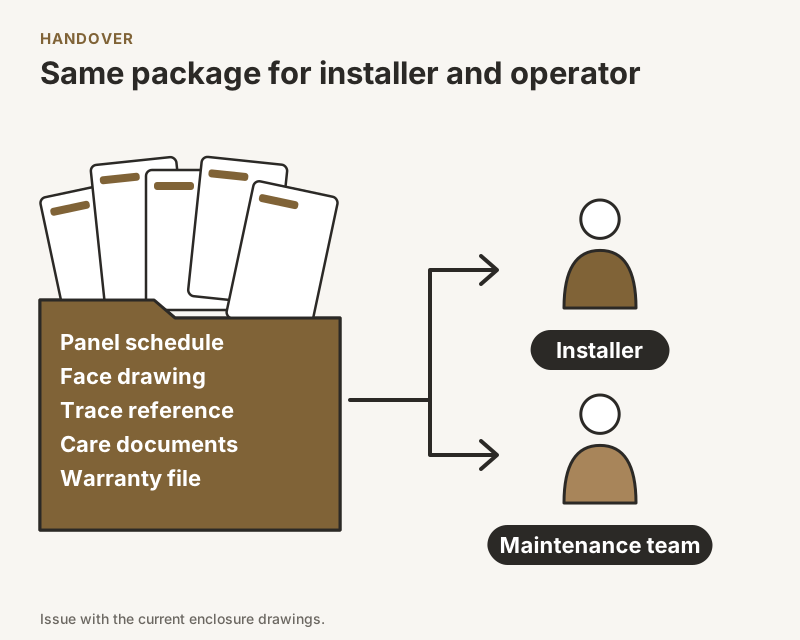
Issue the glass-treatment package with the current enclosure drawings. The installer needs to place the identified faces correctly; the operator needs to care for the treatment actually received.
| Reference | Record to hand over |
|---|---|
| Panel schedule | Panel IDs and confirmed treatment identity |
| Face drawing | Treated face and shower/room orientation |
| Trace reference | Supplier or application reference linked to the panels |
| Care documents | Product, market and version/date of supplied instructions |
| Warranty file | Actual terms and required retained records |
Before you close the file
- The drawing and care sheet refer to the same named treatment.
- Both teams can identify which panels the documents cover.
- Any changed treatment has a revised handover set.
An easy-clean option is ready to hand over when its identity survives the journey from quotation to installed panel. Written confirmation of WNS supply scope and the documentation available for a proposed order is separate from these manufacturer examples.