From identity to release
Which dates are being compared?
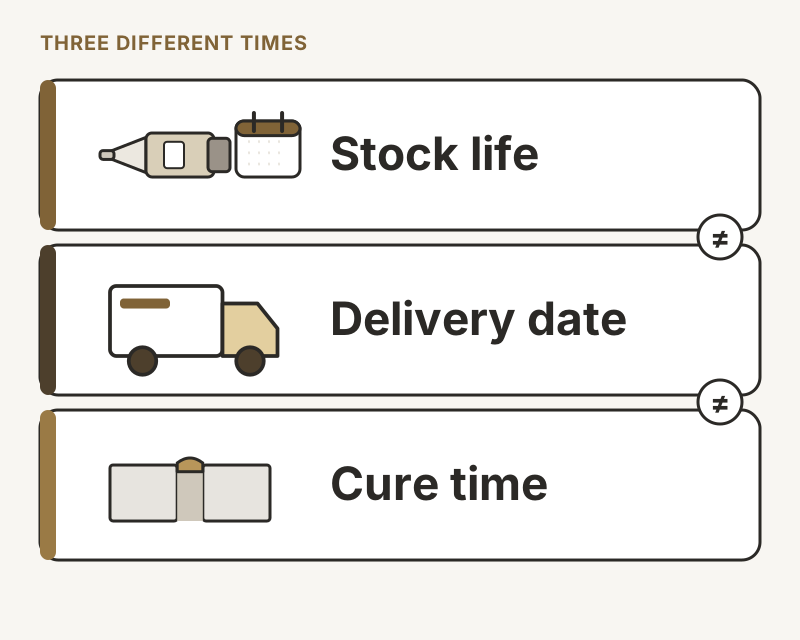
Keep stock life and installed-joint cure separate. A delivery date tells you when the goods arrived; it does not by itself tell you when the product was made, whether it was stored correctly or how long an applied bead needs.
Before discussing a remaining-use window, identify the product and the actual date basis on its packaging or maker guidance. A batch code that looks like a date should stay undecoded until the supplier confirms its meaning.
| Record | What to establish |
|---|---|
| Production date | The maker’s identified starting reference |
| Expiry/use-by reference | An explicit package date or confirmed basis |
| Delivery date | The receiving event, not a reset of shelf life |
| Planned use | The intended opening/application window |
| Cure time | A separate installed-joint instruction |
What should be settled before the batch is shipped?
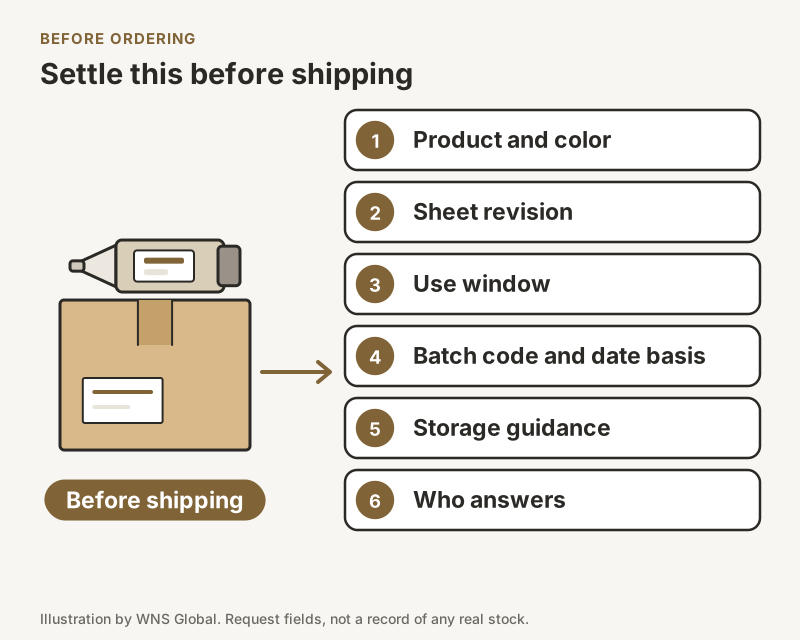
Specify the proposed installation window and request product/date/storage information while the supplier can still identify the stock being allocated.
- Name the exact product, color and market-specific product-sheet revision proposed for the joint.
- Keep compatibility approval separate from the unopened stock-life review.
- State the planned use window and any contract requirement for remaining shelf life at delivery; do not invent a universal percentage.
- Ask how the actual package identifies the batch and the relevant date basis.
- Request the storage guidance and an explanation of known custody or condition exceptions.
- Agree who answers unreadable codes, damaged packaging or a schedule that changes after delivery.
These are request fields, not evidence that a supplier maintains a particular storage system. Do not promise that a quoted material remains usable simply because the order refers to a suitable brand.
What does the named product sheet actually say?
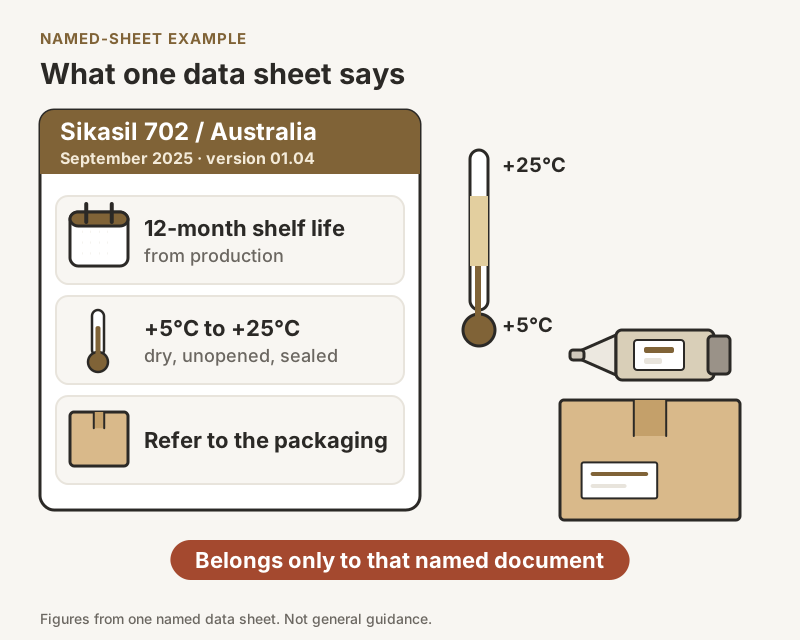
Sikasil 702’s Australian data sheet, September 2025 version 01.04, gives a 12-month shelf life from production and specifies dry, original unopened undamaged sealed storage at +5°C to +25°C. It says to refer to the packaging. These figures belong only to that named document.
Swipe or use the arrow keys to see question for the actual order.
| Source field | Limited example | Question for the actual order |
|---|---|---|
| Product and market | Sikasil 702 / Australia | Is this the exact offered local product? |
| Life basis | From production, not receipt | How is the actual date confirmed? |
| Storage condition | Unopened original sealed packaging | What is known about this batch? |
| Local scope | Local product data may vary | Which current local sheet applies? |
Do not transfer the example values to another silicone, region or opened cartridge. This table does not decide whether an actual batch is suitable, and it does not claim WNS Global supplies this product.
How should an unclear batch remain visible?
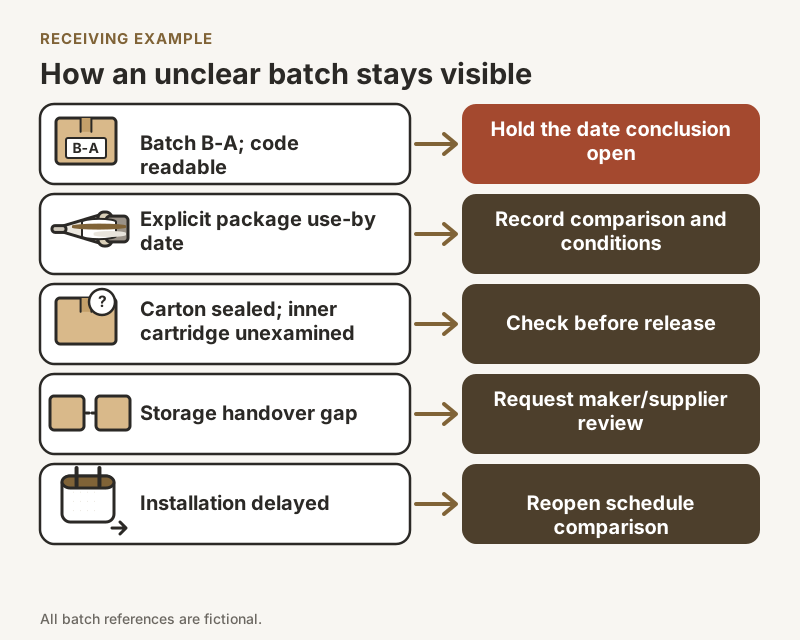
The following fictional record illustrates decisions, without manufacturing a label or assigning a date to an unknown code.
Swipe or use the arrow keys to see receiving state.
| Observed record | Question | Receiving state |
|---|---|---|
| Batch B-A; code readable | Maker decoding not yet confirmed | Hold the date conclusion open |
| Explicit package use-by date | Does planned use precede it? | Record comparison and conditions |
| Carton sealed; inner cartridge unexamined | Is the actual package undamaged? | Check before release |
| Storage handover gap | Can responsible party explain conditions? | Request maker/supplier review |
| Installation delayed | Does the accepted window still apply? | Reopen schedule comparison |
The purpose of the record is to prevent a convenient assumption from becoming a release decision. Received does not mean approved for use. The person responsible for closing the issue should identify the evidence or maker response, not merely change the cell to acceptable.
What should the receiver record without guessing?
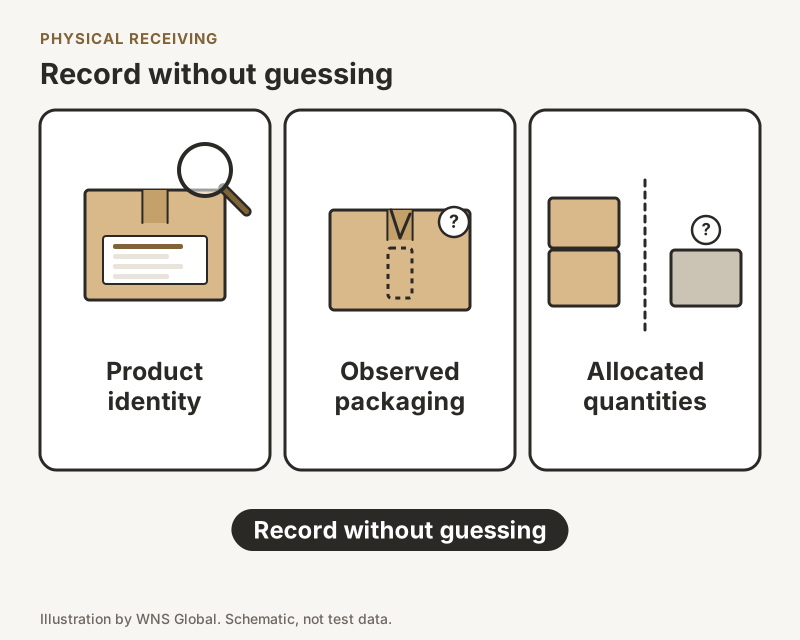
Use direct observations for the packages actually received and separate them from conclusions that require product guidance.
Preserve product identity
Record the product name, color, local sheet reference and readable batch information. A similar cartridge design is not enough to establish the formulation or its guidance.
Describe the observed packaging
Note seal or package damage and the affected quantity. Do not report unopened as a verified condition if the relevant cartridge has not been examined.
Keep quantities allocated
Identify which boxes or cartridges belong to the unresolved batch reference so that the installation team does not mix them into accepted stock.
- Record observations and package references.
- Retain the unresolved date or condition question.
- Separate questioned stock from the use allocation.
What if storage conditions are uncertain?
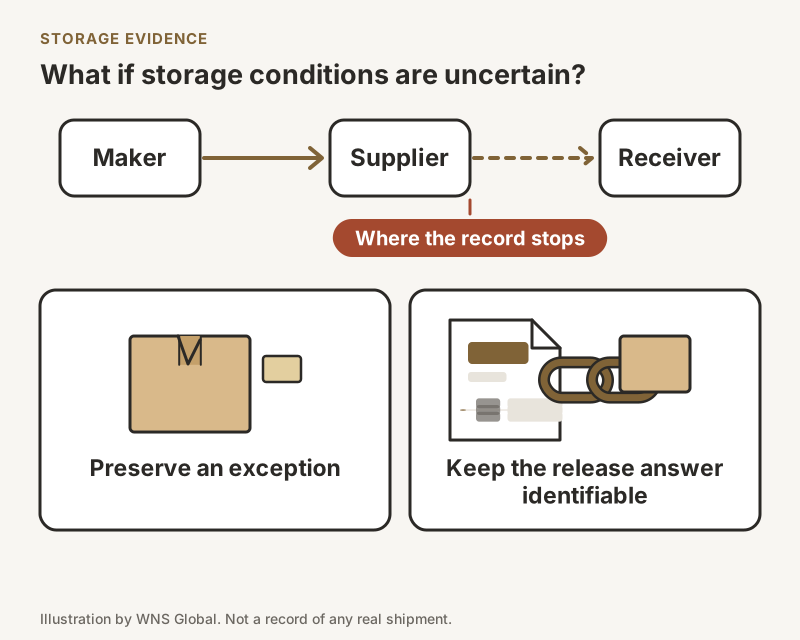
The named product sheet states storage conditions; a clean-looking cartridge is not a record of every earlier condition.
Ask for the known custody record
Identify what the supplier or receiver actually knows and where the record stops. An assertion of correct storage should have a stated basis.
Preserve an exception
Record a known exposure or damaged seal without declaring its effect on performance. Refer the actual product and facts to the manufacturer or responsible qualified party.
Keep the release answer identifiable
Retain the response that addresses this batch and the planned use. A general brochure is not a decision on an unexplained exception.
Do not invent an accelerated-age test, extend a date or give a generic “still safe” judgement. If the storage basis cannot be established, keep the issue open rather than treating the remaining calendar time as the only acceptance condition.
Which fields keep the batch and schedule connected?
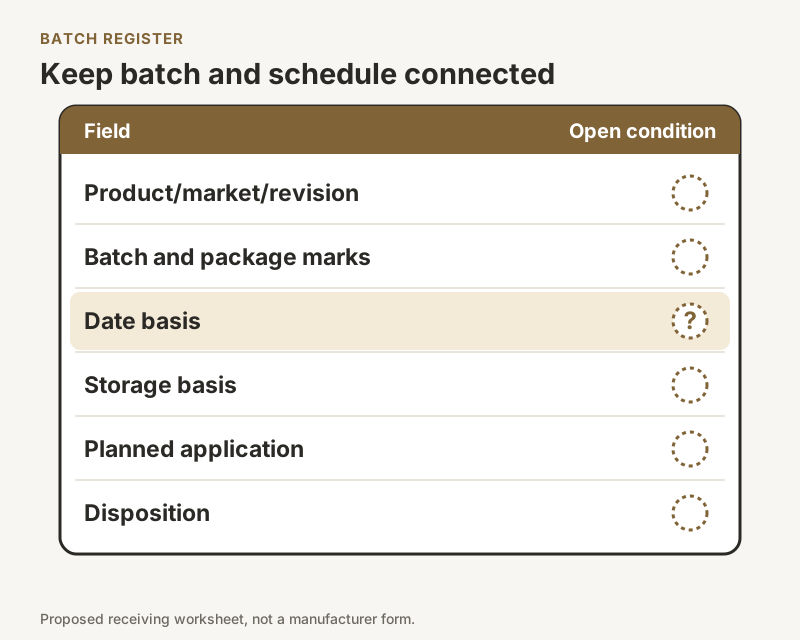
This is a proposed receiving worksheet, not a manufacturer’s mandatory form.
Swipe or use the arrow keys to see open condition.
| Field | Record | Open condition |
|---|---|---|
| Product/market/revision | Exact local guidance reference | Similar name or old sheet |
| Batch and package marks | Which stock the review describes | Unreadable or mixed identity |
| Date basis | Confirmed production/expiry reference | Uninterpreted code |
| Storage basis | Known custody and exceptions | Unexplained gap |
| Planned application | Intended use window | Schedule moved |
| Disposition | Who resolved what and when | General assurance only |
What changes when installation is delayed or a cartridge is opened?
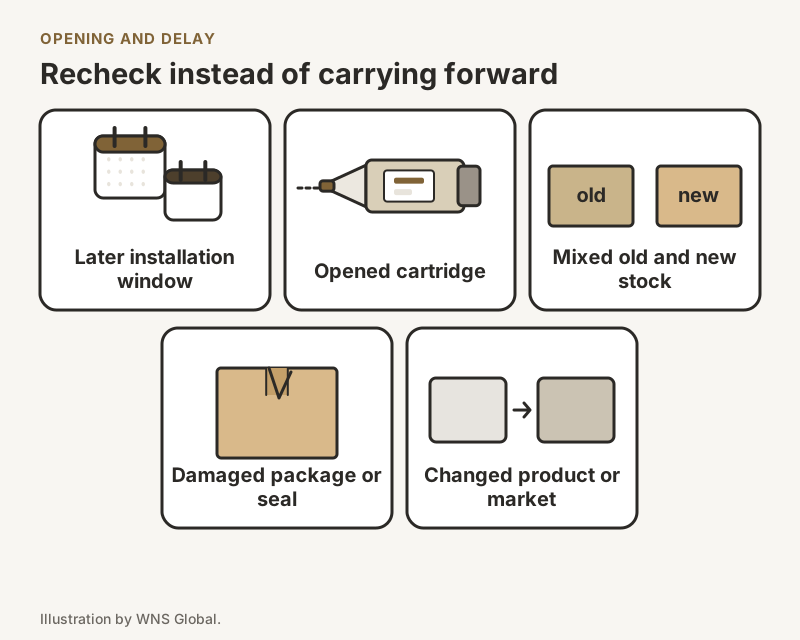
Recheck the actual situation instead of carrying forward a conclusion that described different stock or a different time window.
- Later installation window Compare it again with the confirmed date basis and recorded conditions; do not silently update the delivery date.
- Opened cartridge The named sheet’s unopened storage statement is not an after-opening life instruction. Request the maker’s actual guidance.
- Mixed old and new stock Keep the relevant batch identities visible; a recent delivery does not refresh an older cartridge.
- Damaged package or seal Describe the actual observation and obtain the appropriate product-specific disposition.
- Changed product or market Reopen identity, local guidance and compatibility rather than retaining the old batch review.
Record the disposition
Installed-joint skin, tack-free and cure instructions belong to the separate cure guide and the actual product sheet. Passing this receiving review cannot establish that a later joint is fully cured or compatible.
What should the installer receive with released stock?
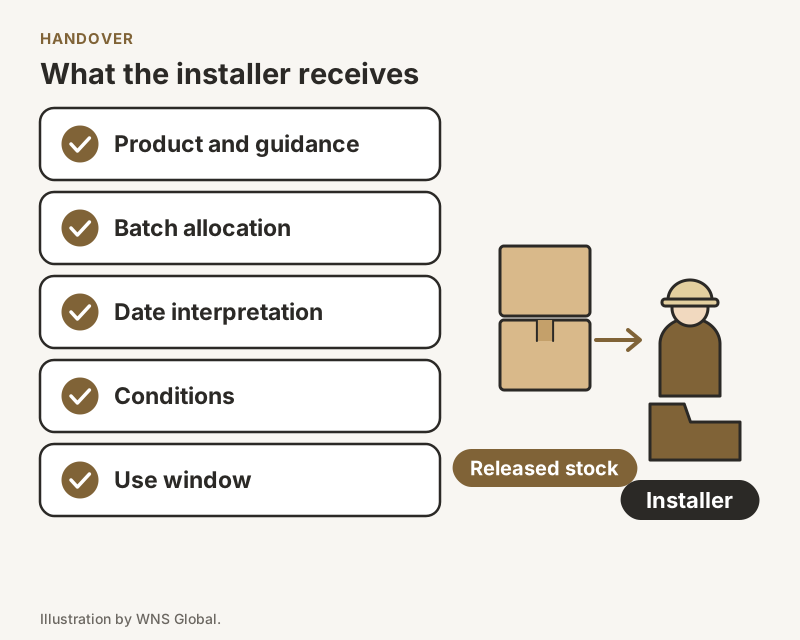
Provide the identified stock, applicable guidance and current disposition together. A release file should not conceal an uncertainty that installation will inherit.
| Reference | Record to hand over |
|---|---|
| Product and guidance | Current local product-sheet reference |
| Batch allocation | The physical stock described by the review |
| Date interpretation | Confirmed basis and evidence reference |
| Conditions | Recorded storage basis and resolved exceptions |
| Use window | Accepted schedule and trigger for recheck |
Before you close the file
- The actual product and market are identified.
- The batch/date basis is confirmed rather than guessed.
- Known condition questions have a relevant disposition.
- A delayed installation reopens the comparison.
No WNS Global stock life, storage capability, product availability or sealant performance is asserted. Actual product selection, supply scope and installation guidance require separate confirmation.