From identity to release
Which purchasing question is the report supposed to answer?
Write the question before reading the hour count. You might need evidence for an agreed corrosion evaluation of a particular finish on an offered component. That is narrower than proving that every product carrying the same finish name will perform identically in every bathroom.
Keep the offered part and report identity side by side. A report on a development coupon can be relevant supporting evidence, but its relationship to the supplied component requires an explanation. A name such as brushed brass or PVD does not complete that connection.
| Record | What to establish |
|---|---|
| Offered part | Model, component and finish reference |
| Report identity | Issuer, number and report date |
| Buyer question | The defined property and product scope to be assessed |
| Claim received | Original supplier wording, including qualifications |
| Open issue | Missing identity, criterion or scope explanation |
How should the method and edition be recorded?
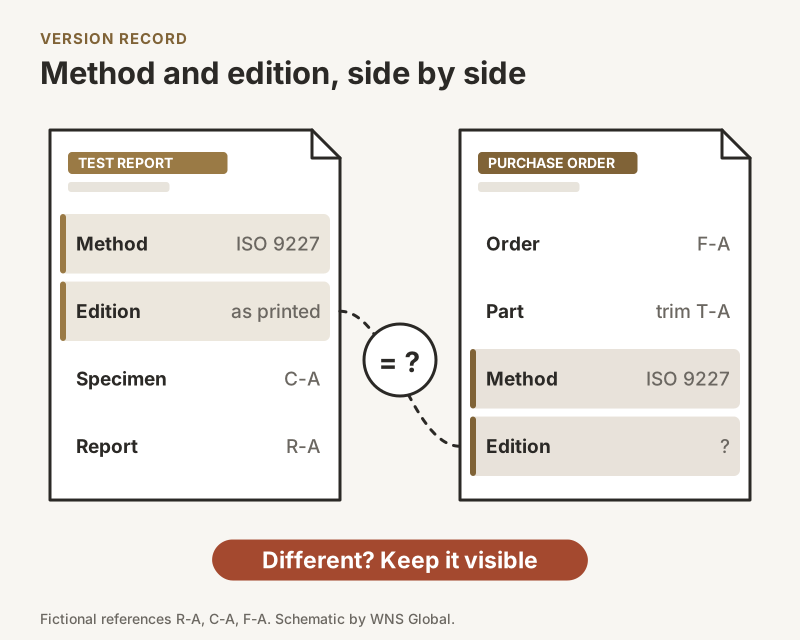
A report date, a method edition and a product specification are different references. Preserve all of them where supplied, rather than replacing the report’s edition with the newest one found online.
- Read the method designation exactly as reported, including revision or edition.
- Record the report date and any separate customer or product specification reference.
- Ask the laboratory to clarify an omitted edition or ambiguous method description.
- Keep an older report’s stated method intact; ask whether the agreed order requires another edition.
- For ISO-based evidence, record any amendment identified in the actual report or applicable requirement.
The official public pages identify ASTM B117-26a as active, updated September 22, 2026, and ISO 9227:2022/Amd 1:2024 as a published amendment. Amendment metadata alone does not reveal its full requirements. A newer publication does not, by itself, resolve whether an older report satisfies the buyer’s agreed scope.
Why must the salt-spray type be explicit?
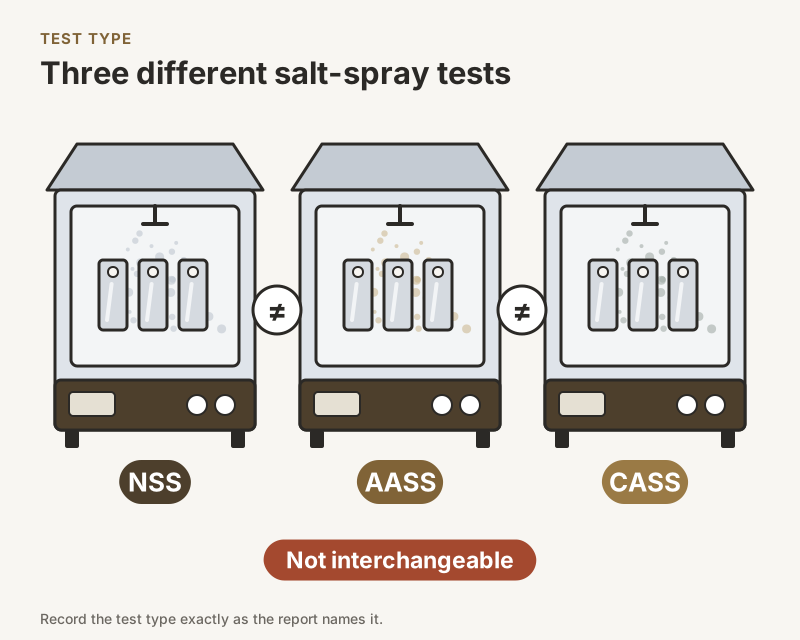
ISO 9227:2022’s public abstract identifies NSS, AASS and CASS within its scope. The method type is part of the evidence identity; a heading saying salt spray is not enough to make unlike reports comparable.
Swipe or use the arrow keys to see interpretation limit.
| Reported field | Review action | Interpretation limit |
|---|---|---|
| NSS, AASS or CASS | Preserve the actual reported designation | Do not treat the names as interchangeable |
| Method absent | Request the laboratory’s identified method | Do not infer it from the exposure duration |
| Customer requirement | Read it alongside the reported method | Do not invent a universal hour threshold |
| Two different methods | Ask what comparison the technical party supports | Do not simply rank their hour counts |
This page does not reproduce the procedures for any of these tests. It gives the buyer a place to record the method that was actually used and the question the report is intended to answer.
What must connect the tested sample to the offered part?
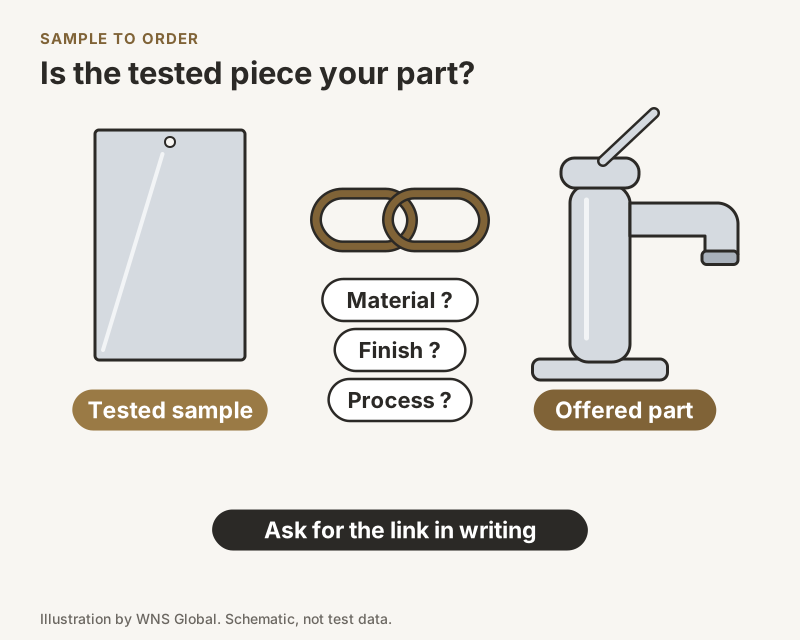
Separate a flat coupon, a component and an assembled product in the worksheet. Ask the supplier which one the report describes and how its construction relates to the order.
Swipe or use the arrow keys to see question still to resolve.
| Fictional reference | Known field | Question still to resolve |
|---|---|---|
| Report R-A / coupon C-A | Flat specimen carrying finish X | How does its substrate and process relate to order F-A? |
| Order F-A / trim T-A | Offered component and finish reference | Is the tested process the one offered for this component? |
| Report photograph | Visible specimen reference | Does it establish the actual specimen identity? |
| Changed substrate or finish process | New order revision | Does the prior evidence remain relevant? |
Use the actual report’s specimen description, preparation and identified finish information. Do not fill absent fields with expected catalog data. A matching decorative color is not evidence that substrate, preparation and coating system were the same.
Which specimen details can change the reading?
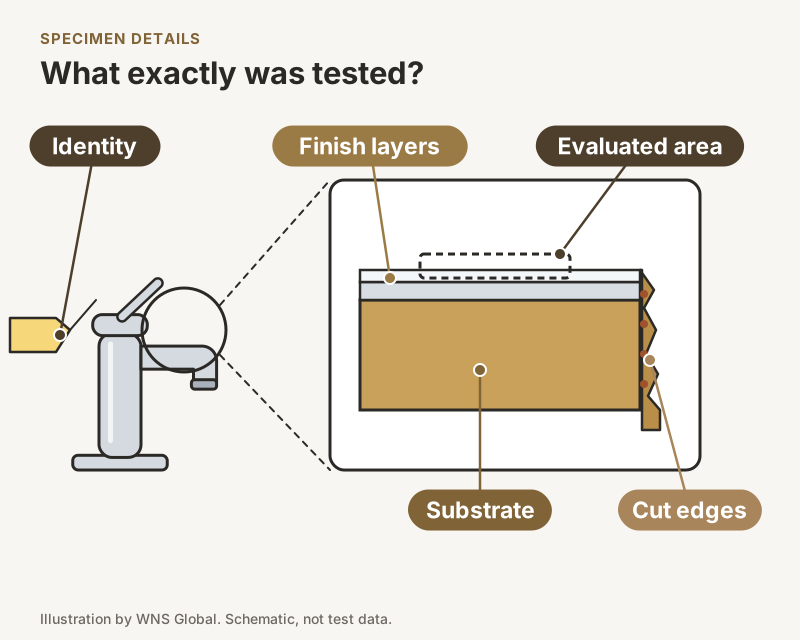
The buyer should read the conditions and specimen information already reported, then ask the laboratory about missing context. This is not an instruction to set up or modify a test.
Preparation and surface condition
Record the described substrate, finish and preparation. Ask whether the specimen represents the offered production condition; do not assume a supplier’s best-looking sample represents every delivered part.
Areas included in evaluation
Look for the stated treatment of edges, marked areas and any scribe where relevant to the report. Ask what was evaluated instead of comparing an edge observation with a different report’s main-surface result.
Exposure and observations
Preserve the reported duration, observation points and specimen identification. A final photograph may be useful, but it does not replace the laboratory’s description of how the result was evaluated.
- Describe the specimen as reported.
- Retain the actual exposure and observation fields.
- Refer unclear technical fields to the reporting laboratory.
Where does the pass or fail criterion come from?
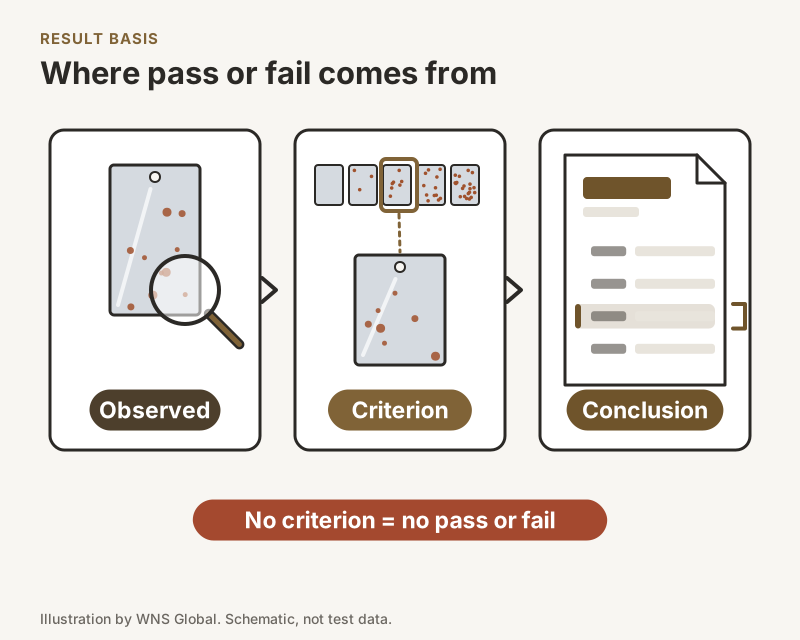
A method designation and an exposure duration do not automatically establish a product acceptance criterion. Ask which requirement the reported conclusion is being measured against.
Find the evaluation reference
ASTM’s public summary says B117 does not prescribe particular specimen types, periods or interpretation of results. A pass statement therefore needs its own identified product or agreed evaluation basis.
Identify the reported condition
Keep the evaluated corrosion condition, location and observation point with the conclusion. Do not rewrite no observed defect in a stated area as proof that every area or property was assessed.
Keep the scope of ISO evidence visible
ISO’s public abstract similarly leaves product-specific specimen and result interpretation outside this generic test description. The buyer should retain the applicable product requirement or ask the responsible party for it.
If the report provides no identified acceptance basis, record the reported observations without creating a pass threshold yourself. The technical party should explain whether the evidence addresses the order’s agreed question.
When are two reports a useful comparison?
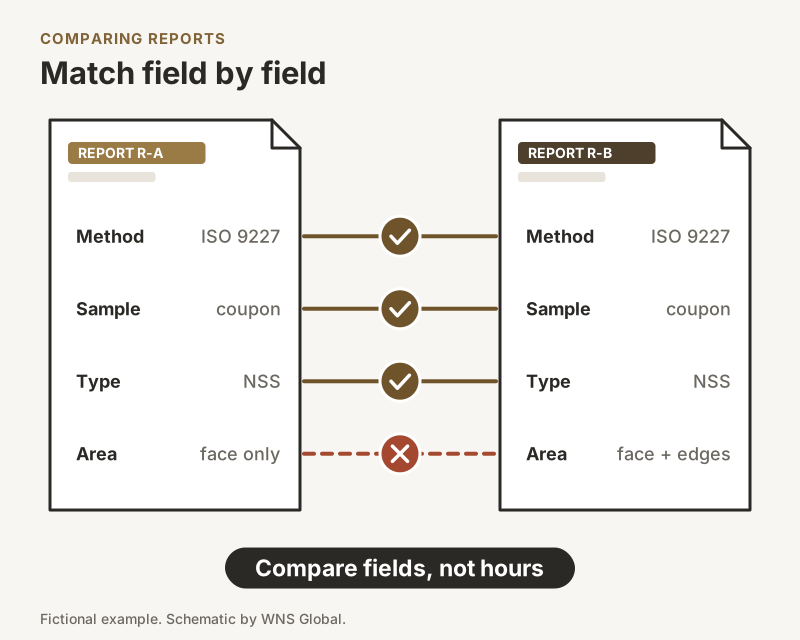
ASTM’s public significance statement discusses variation and the need for corroborating evidence. A comparison should begin with aligned fields, not a larger number.
Swipe or use the arrow keys to see buyer action.
| Field | Report R-A | Report R-B | Buyer action |
|---|---|---|---|
| Method and edition | As reported | As reported | Resolve differences before ranking |
| Specimen and finish | Identified construction | Identified construction | Explain relation to each offered part |
| Preparation / evaluated area | Reported scope | Reported scope | Check whether observations concern the same area |
| Acceptance reference | Defined criterion or absent | Defined criterion or absent | Do not compare unlike pass statements |
| Laboratory context | Reported conditions and limitations | Reported conditions and limitations | Ask what qualified comparison is supported |
Why should hours stay separate from years in service?
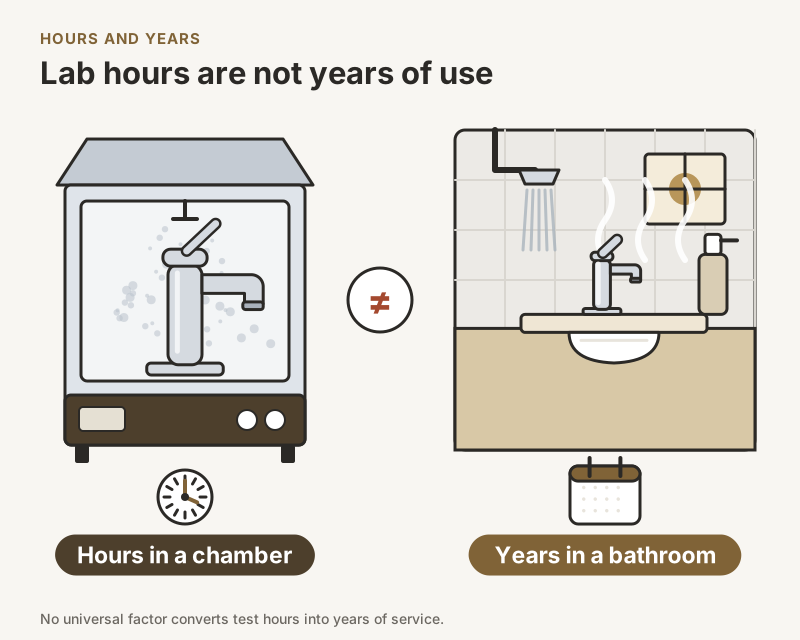
A chamber exposure is not a calendar accelerated by a universal factor. Bathroom use introduces its own environment, cleaning, design and maintenance questions.
- Reject an unsupported conversion If a sales claim turns a laboratory hour count into years of service, ask for the basis. This page provides no multiplier and no replacement service life promise.
- Ask what corroborates field performance ASTM’s public summary cautions against using salt-fog results alone to predict natural-environment performance. Keep relevant field or service evidence separate from the laboratory result.
- Do not infer unrelated resistance A corrosion report does not automatically answer abrasion, cleaner compatibility, color matching or every mechanism affecting the finished part. Request evidence for the property actually important to the project.
- State a limited purchasing conclusion The evidence may support an agreed laboratory evaluation for an identified specimen. Say that, and preserve uncertainty about the service conditions it did not address.
Record the disposition
This distinction helps a buyer use a relevant report without turning it into an unsupported warranty. A service-life or maintenance commitment must be agreed separately with the responsible supplier.
What should the buyer retain after reviewing the report?
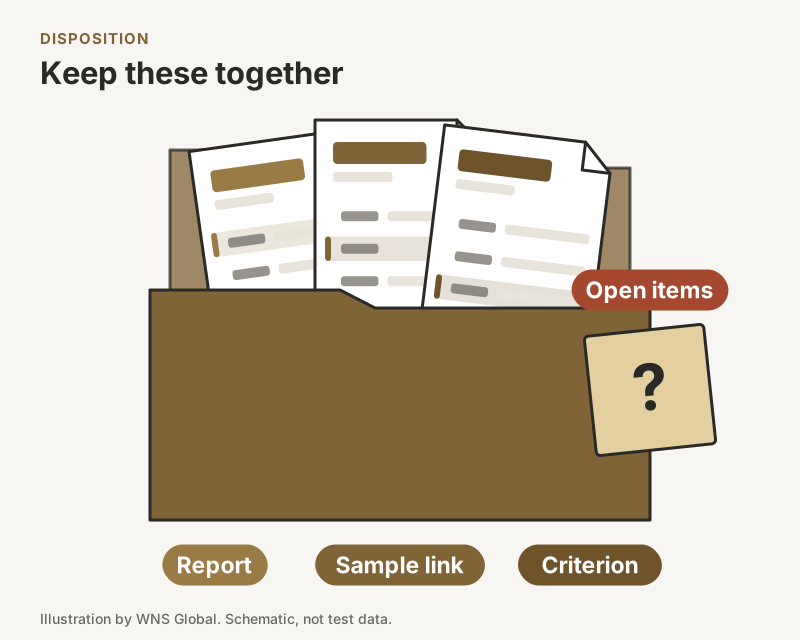
Close the review with a statement that identifies the evidence, the question it answers and any remaining gaps.
| Reference | Record to hand over |
|---|---|
| Identity link | Offered component and tested specimen relationship |
| Method reference | Actual method, edition and supplied amendment reference |
| Evaluation basis | Criterion, evaluated location and reported result |
| Comparison limits | Differences that prevent a simple ranking |
| Disposition | Accept defined evidence, seek clarification or leave scope open |
Before you close the file
- The sample connects to the offered part by evidence, not appearance.
- A result has an identifiable evaluation basis.
- No laboratory hour count has become a service-life guarantee.
Keep the original report and the supplier or laboratory’s clarifications together. This guide does not represent any WNS Global finish as tested, certified or warranted for a specified corrosion exposure.